
Football rules for beginners: offside, fouls, cards
Football's laws are short, but a few decisions confuse new fans: offside, fouls, cards and penalties. This guide explains them with simple examples.
The basics
- Two teams of up to 11 players, one of whom is the goalkeeper. A match cannot continue if a team has fewer than seven players.
- A match is 90 minutes in two halves of 45. The referee adds time at the end of each half for stoppages (injuries, substitutions, delays).
- A goal is scored when the whole ball crosses the goal line between the posts and under the crossbar.
- The team with more goals wins. If the scores are level, league matches are drawn. In knockout matches extra time (two periods of 15 minutes) and then a penalty shoot-out can follow, depending on the competition.
The offside rule
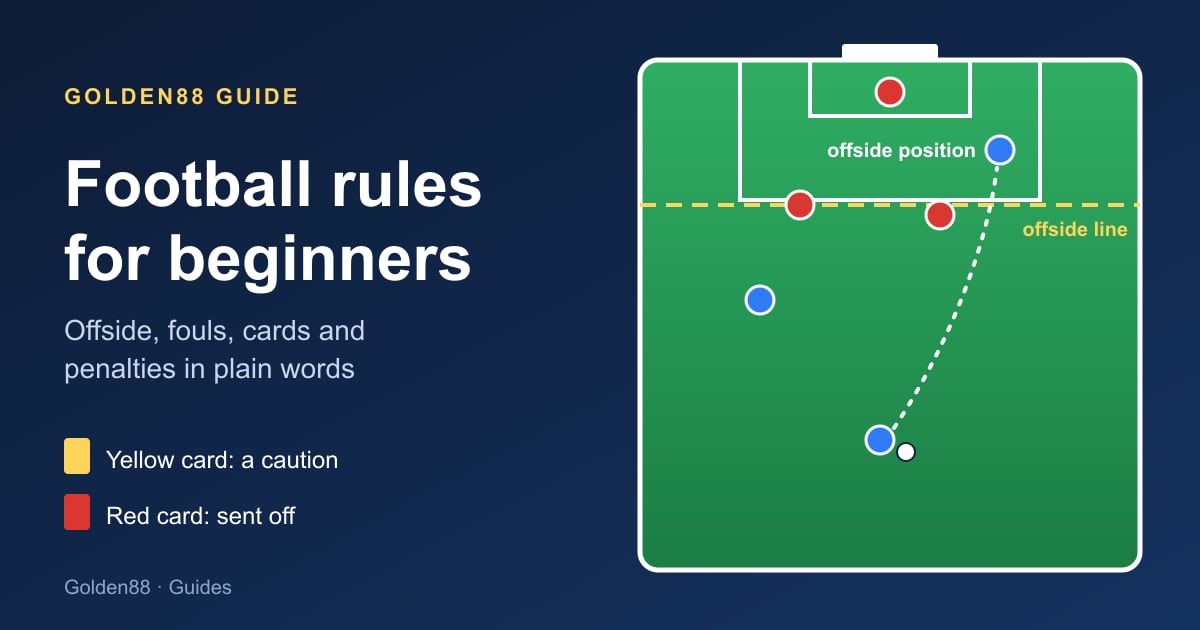
A player is in an offside position if, at the moment a teammate plays or touches the ball to them, any part of their head, body or feet is in the opponents' half and nearer to the opponents' goal line than both the ball and the second-last opponent. The goalkeeper usually counts as one of the two opponents, so a striker is normally in an offside position when only the goalkeeper is nearer to the goal line. Hands and arms are not counted.
Being in an offside position is not an offence in itself. A player is only penalised for offside if they take part in active play: playing the ball, interfering with an opponent, or gaining an advantage from being there. A player cannot be offside from a goal kick, a throw-in or a corner kick, in their own half, or when they are level with the second-last opponent or the ball.
Fouls and free kicks
A direct free kick (from which a goal can be scored straight away) is given for careless, reckless or forceful contact: kicking, tripping, pushing, charging, striking or holding an opponent, and for deliberately handling the ball. If the foul is committed by a defending player inside their own penalty area, the result is a penalty kick instead.
An indirect free kick (a goal can only be scored if another player touches the ball first) is given for offences such as dangerous play, obstructing an opponent, or a goalkeeper picking up a ball that a teammate deliberately kicked to them.
The referee can also play advantage: if the team that was fouled still has a good chance to attack, play continues and the foul is not stopped.
Yellow and red cards
- Yellow card (caution): reckless fouls, time wasting, arguing with the referee, unsporting behaviour or persistent fouling.
- Two yellow cards in the same match mean a red card.
- Red card (sending-off): serious foul play, violent conduct, spitting, offensive or abusive language, or denying the other team an obvious goal-scoring chance by a foul or by deliberately handling the ball.
- A player who is sent off cannot be replaced, so the team plays one player short. Suspensions for the next matches are set by the competition.
Penalty kicks and shoot-outs
A penalty kick is taken from the penalty spot, 11 metres (12 yards) from the goal. Only the kicker and the goalkeeper are involved, and the goalkeeper must keep at least part of one foot on the goal line until the ball is kicked.
In a penalty shoot-out each team takes five kicks, taking turns. If the score is level after five each, the shoot-out continues one kick each until one team scores and the other does not.
Corner kicks, goal kicks and throw-ins
- Throw-in: awarded to the opponents of the player who last touched the ball when it crosses a touchline.
- Goal kick: awarded to the defending team when the attacking team last touched the ball before it crossed the goal line.
- Corner kick: awarded to the attacking team when a defender last touched the ball before it crossed their own goal line.
What is VAR?
The video assistant referee (VAR) helps the referee in four kinds of decisions: goals, penalty decisions, direct red cards and mistaken identity. It is used only to correct a clear and obvious error or a serious missed incident, and the final decision always belongs to the referee on the pitch.
Frequently asked questions
- How many substitutions are allowed? The competition decides. Many leading competitions allow five substitutions per team, made in a limited number of stoppages.
- Who decides how much time is added? The referee, who estimates the time lost to stoppages. The fourth official shows the minimum added time on a board.
- Can a goal be scored directly from a kick-off? Yes. A goal can be scored directly from a kick-off, a goal kick and a corner kick against the opposing team, but not directly from a throw-in.
Where these rules come from
The explanations follow the Laws of the Game published by the International Football Association Board (IFAB), the body that sets football's laws for all competitions. IFAB reviews the laws every year and new editions usually take effect in the summer (recent changes include time limits for substitutes leaving the field and a visible countdown for delayed throw-ins and goal kicks), so check the current edition of the Laws for the latest wording.