
Esports formats explained: BO1, BO3, BO5 and brackets
Esports events are organised in series and brackets that can look confusing at first. This guide explains what BO1, BO3 and BO5 mean and how the most common tournament formats decide a winner.
What BO1, BO3 and BO5 mean
"BO" stands for "best of". The number is the most games (often called maps) the series can last, and a series ends as soon as one side has won more than half of them.
- BO1 (best of one): a single game or map decides the match. It is quick, and an upset is more likely because there is no second chance.
- BO3 (best of three): the first team to win two maps wins. The score is 2-0 or 2-1.
- BO5 (best of five): the first team to win three maps wins. The score is 3-0, 3-1 or 3-2.
- BO2: both maps are always played, so the series can end 1-1. It is used in some group stages, where a draw earns a point.
Why longer series matter
One game can be decided by a lucky moment, a strong map choice or a single mistake. A longer series gives the stronger team time to show it, which is why important matches, such as semi-finals and grand finals, are usually BO3 or BO5.
Maps, drafts and sides
Before a game starts, teams often choose what will be played. In Counter-Strike 2 the teams take turns removing ("banning") and choosing ("picking") maps in a process called the map veto, and the last map left becomes the decider. In games such as Dota 2 and League of Legends each game begins with a draft, where the teams take turns banning and picking heroes or champions.
Single elimination
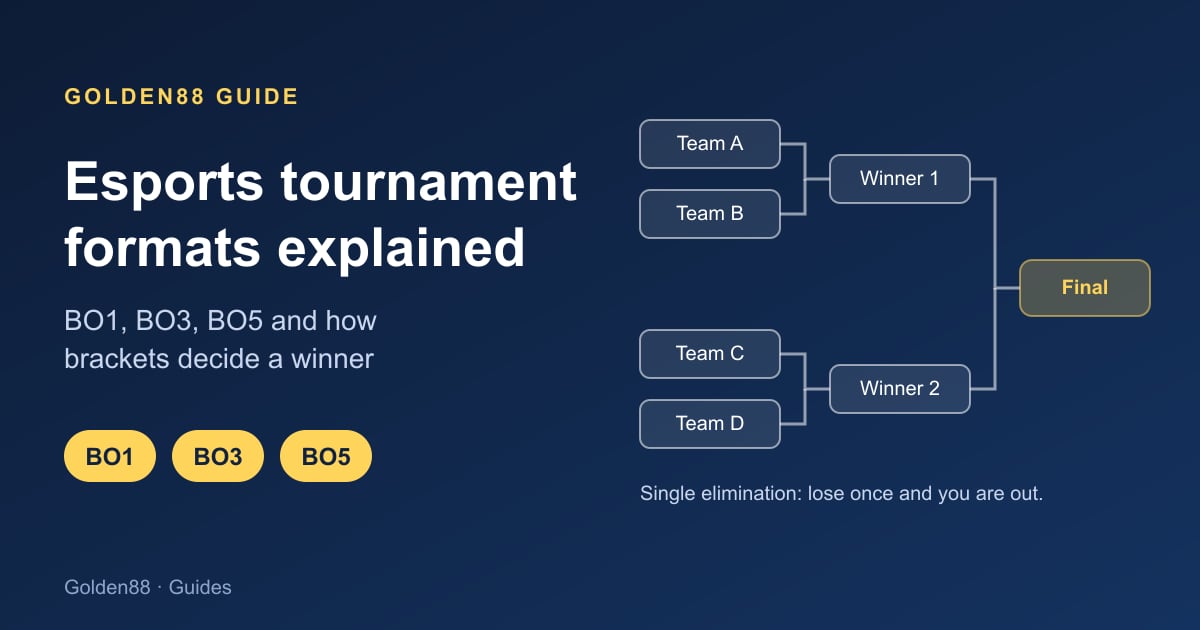
Teams are placed in a bracket and play each other in pairs. The loser of each match is out, and the winner moves on until one team is left. It is the fastest format, but one bad series ends a team's event. Seeds (the ranking used to place teams) are used so that the strongest teams meet later, and a team may get a "bye", which means moving on without playing a round.
Double elimination
A team has to lose twice to be out. The first loss moves a team from the upper bracket to the lower bracket, where one more loss ends its run. The winners of the upper and lower brackets meet in the grand final. In some events the team from the lower bracket must beat the upper-bracket team twice, because it has not lost yet. It gives good teams a second chance and is common in big events.
Round robin and group stages
In a round robin every team in a group plays every other team. Results are turned into a table, usually with points for wins, and the best teams advance to the playoffs. If teams finish level, organisers use tie-breakers such as the result between the tied teams or the difference in maps won and lost.
Swiss system
In a Swiss stage teams are not eliminated at once or paired by a fixed bracket. After each round, teams with the same record play each other. The Counter-Strike 2 Majors, for example, use Swiss stages of 16 teams: three wins send a team through, and three losses eliminate it. Early rounds are mostly BO1 and the matches that decide who advances or goes out are BO3. After the Swiss stages, the best eight teams play a single-elimination playoff. Formats change from event to event.
How to read a schedule or bracket
- Look for the series length next to the match (BO1, BO3 or BO5).
- Find out which stage it is: group stage, Swiss stage, playoffs or final.
- Check whether the event is single or double elimination, because a loss means something different in each.
- Read the event's own rules for tie-breakers, overtime and what happens if a player cannot play.
Frequently asked questions
- What is a seed? A number that ranks a team before the event starts, used to place it in the bracket.
- Why are group matches often BO1? To fit many matches into a short time. The format changes for the playoffs.
- What is a stand-in? A substitute player who joins a team for an event when a regular player cannot play.
Where these formats come from
These are the formats used by the main tournament organisers in esports. Each event publishes its own rulebook, which decides the series length of each round, tie-breakers, overtime and what counts as a forfeit, so always read the rules of the event you are following.